
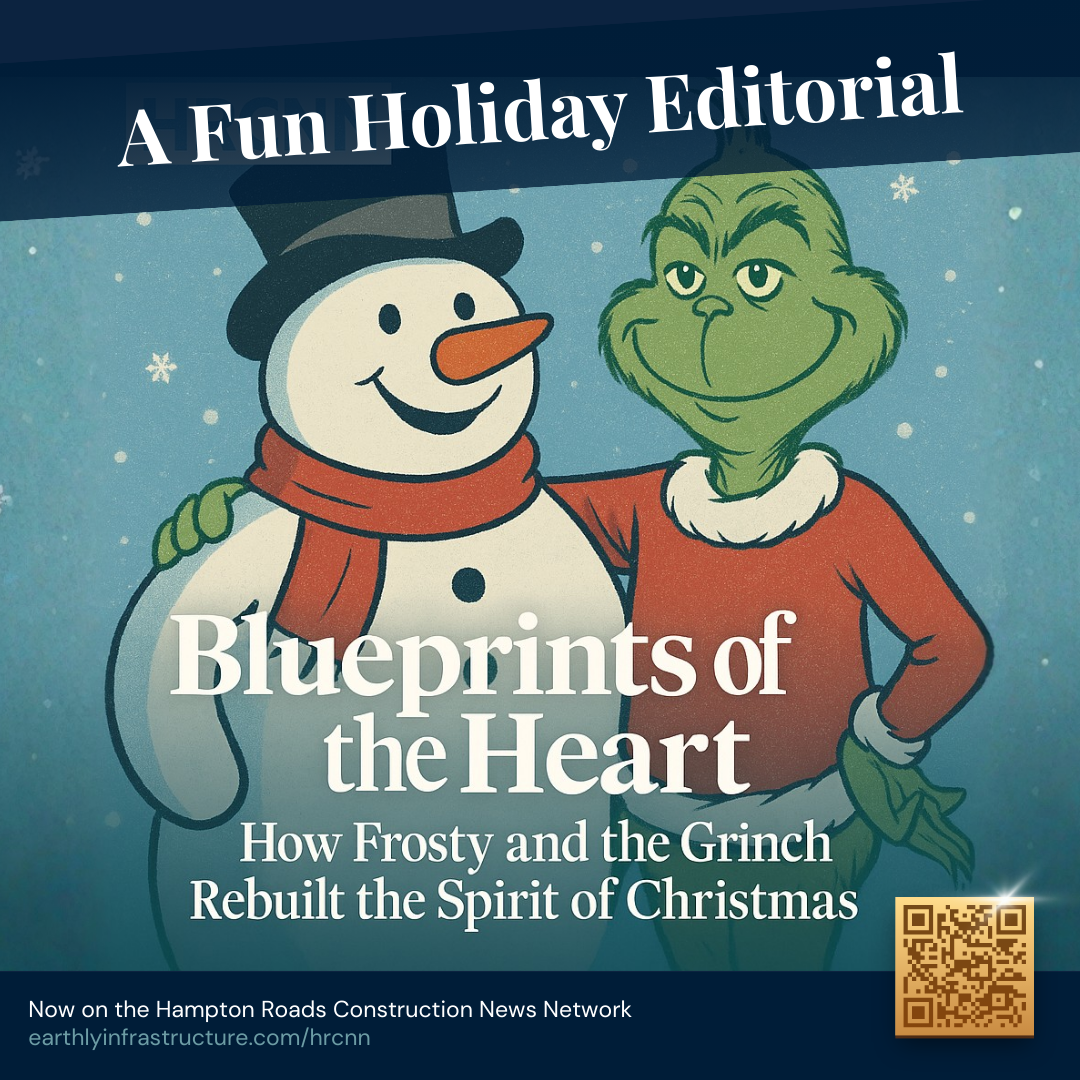
By Eric S. Cavallo, Editor-in-Chief, Hampton Roads Construction News Network
High above the Arctic permitting district—where frost lines double as zoning setbacks and every hard hat comes with earmuffs—a rivalry had taken hold. Two of the North Pole’s most formidable builders, Frosty Construction and the Grinch Development Group, had been locked in an icy feud that turned the winter build season into a snow-covered standoff. Watching from City Hall was Mayor Santa Claus, trying to keep the Christmas capital on schedule while his top contractors froze each other out.
The rift began after the Great Reindeer Garage bid of ’22, when Frosty Construction edged out the Grinch Group by offering free cocoa to subcontractors and promising to “build with heart.” The Grinch filed a grievance, calling the gesture “emotional interference.” The claim melted under review, but the resentment didn’t. From that day forward, the two firms sparred over everything from sleigh-route paving contracts to candy-cane zoning overlays.
This year, Santa announced what he hoped would unify the community: the North Pole Transit Hub Redevelopment, a public-private partnership meant to modernize sleigh logistics and provide hundreds of new elf-scale jobs. Instead, it reignited the rivalry.
Frosty’s design emphasized open courtyards, snow-angel parks, and gingerbread-trimmed façades. The Grinch countered with a sleek, fully automated hub powered by peppermint-turbine energy. Each insisted their plan alone could “save Christmas.”
What began as a disagreement over design soon escalated into a full-scale frostbite of public relations. Frosty accused the Grinch of stealing his signature hat-shaped dome design; the Grinch alleged Frosty’s snow-mortar mix violated the Frost Load Reduction Ordinance. Even the elves took sides. By early December, city hearings had devolved into snowball arguments, and the season’s spirit was buried under red tape.
Then came the crisis no one anticipated—a sudden heatwave that melted the supply roads and flooded the toy depots. With Christmas Eve deliveries at risk, the North Pole’s economy and morale teetered on collapse. There was no time for bidding or politics, only action. And for the first time in years, Frosty and the Grinch both stepped forward—not as competitors, but as neighbors.
Frosty rallied volunteers to redirect runoff and fortify the permafrost. Hours later, the Grinch Group arrived unannounced, deploying mobile chillers and candy-cane drones to stabilize the site. The two didn’t speak at first; they just worked—shoulder to shoulder, shovel to shovel—each realizing the community they built for mattered more than the contracts they fought over. As night fell over the frozen skyline, a quiet truth settled in: saving Christmas would require both of them.
For days they labored together under the northern lights. Frosty marveled at the Grinch’s precision and innovation; the Grinch was moved by Frosty’s warmth and selflessness. Somewhere between steel and snow, the wall between them began to thaw. Without instruction or oversight, the two builders merged crews, pooled resources, and shared credit. The rivalry that once defined them gave way to the partnership that would define their legacy.
By December 23rd, the Transit Hub was operational. Sleighs rolled down refrozen lanes, elves returned to their workshops, and toy deliveries resumed. When Santa arrived for inspection, he found both companies standing side by side beneath freshly fallen snow, their new plaque reading: “Built Together, in the Spirit of Christmas.” No decree had ordered it, no award demanded it—they had simply remembered what they were building for.
As the first sleigh bells rang across the horizon, Frosty extended a gloved hand. The Grinch accepted. In that moment, the North Pole saw something far greater than a completed project—it saw the rebuilding of faith, friendship, and purpose. Sometimes, it turns out, the strongest foundation isn’t poured or mixed; it’s felt.
About HRCNN:
The Hampton Roads Construction News Network provides accurate, balanced coverage of construction, zoning, and infrastructure throughout Virginia. From city hall to job site, HRCNN tells the stories behind the structures—connecting builders, policymakers, and communities from the Bay to the Blue Ridge.
